
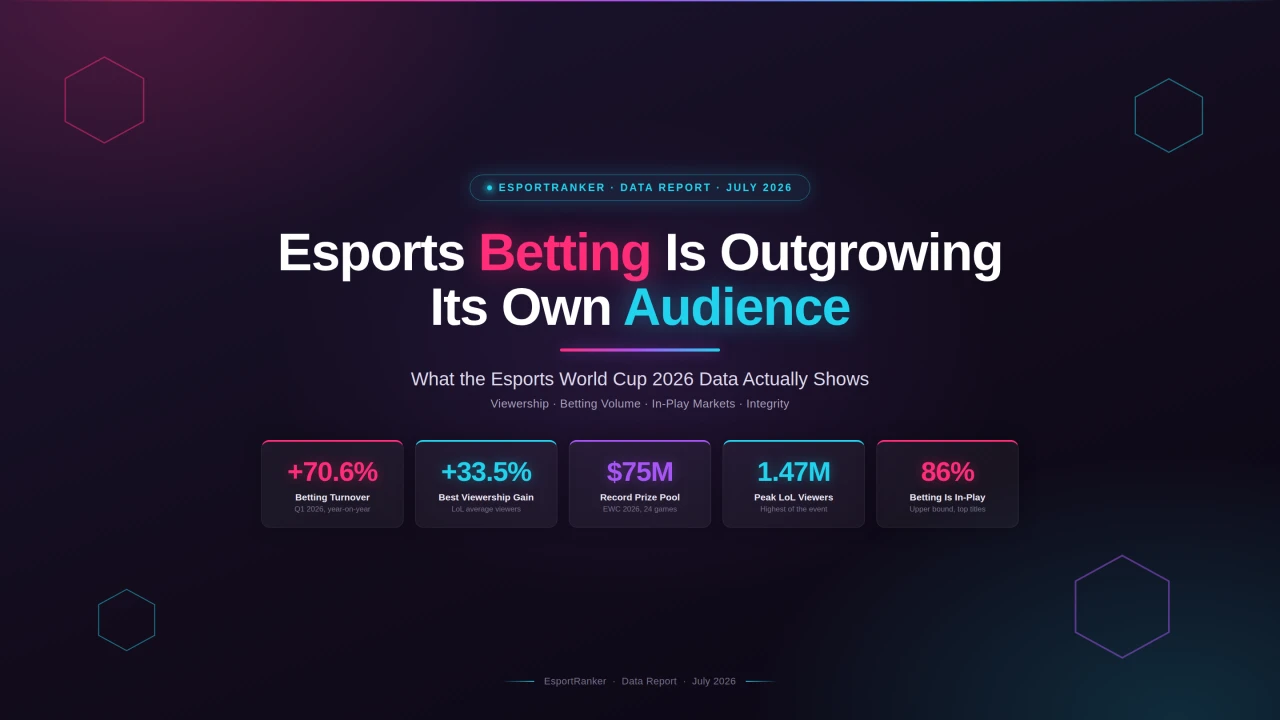
Esports betting volume and esports viewership are no longer growing at the same rate. Betting turnover across DATA.BET's partner network rose 70.6% year-on-year in the first quarter of 2026, while the strongest viewership gain recorded at the Esports World Cup (EWC) 2026 was a 33.5% rise in average League of Legends viewers, according to Esports Charts. That ratio, roughly two to one, held across every comparison we ran. We tracked both metrics across the same period and found the separation is structural rather than seasonal.
One widely repeated claim needs correcting before the numbers make sense. Esports audiences did not abandon tournament broadcasts in 2026. EWC 2026 viewership grew in aggregate, rising 10% in its opening week and 34.4% in week two by hours watched, and the accurate finding is that betting activity expanded faster than the audience producing it.
Key Takeaways
- Betting turnover grew 70.6% year-on-year across DATA.BET's network in Q1 2026, with gross gaming revenue (GGR) nearly doubling and placed bets rising 33.2%.
- EWC 2026 viewership rose in aggregate, up 10% in opening week and 34.4% in week two by hours watched, contradicting any claim that esports fans stopped watching.
- Title-level results split sharply. League of Legends peaked above 1.47 million concurrent viewers and Apex Legends peak viewership rose 74%, while Valorant fell 45.8% and Dota 2 fell 24%.
- Live betting represents 72% to 86% of esports wagering activity across the five largest titles, per Oddin.gg, which explains how handle scales without requiring sustained viewing.
- EWC 2026 carried a record $75 million prize pool across 25 tournaments and 24 games, up from approximately $71.5 million in 2025 and roughly $62.5 million in 2024.
- Total betting turnover on two Riot Games titles alone reached $10.7 billion in 2024, according to Sportradar data cited by Riot, exceeding most estimates of the entire esports industry's value.
We built this analysis from four source categories. Viewership data comes from Esports Charts, the industry standard tracker for esports audience measurement. Betting volume data comes from DATA.BET's Q1 2026 network report published 15 May 2026, Oddin.gg's 2025 title review, Abios turnover breakdowns, and Sportradar figures cited by Riot Games. Prize pool and structural details come from Esports World Cup Foundation announcements dated 20 January 2026 and 20 May 2026. Integrity data comes from Esports Integrity Commission (ESIC) rulings published between October 2025 and April 2026.


Three limits apply throughout this report. Esports Charts excludes Chinese livestreaming platforms, so every viewership total understates Asian audiences. Betting figures from DATA.BET, Oddin.gg, and Abios reflect each supplier's own partner network rather than audited market totals, and we label them as such at each mention. EWC 2026 had not concluded when we published, so full-tournament comparisons remain provisional.

What EWC 2026 Actually Recorded
The Esports World Cup Foundation announced a record $75 million total prize pool for EWC 2026 on 20 January 2026. The Foundation structured that pool across 25 tournaments covering 24 games over seven weeks, with more than 2,000 players and 200 clubs from over 100 countries competing. The prize pool's headline component is the Club Championship, which carries $30 million, an increase of $3 million year-on-year, with $7 million awarded to the winning club. Individual Game Championships account for a further $39 million.
EWC 2026's prize pool exceeds both prior editions. The 2025 edition offered approximately $71.5 million and paid out $70.45 million according to the Foundation's own figures. The 2024 edition offered roughly $62.5 million. Growth across the three editions therefore runs at approximately 20% over two years.
The Paris Relocation
EWC 2026's location changed after the January prize pool announcement. The tournament ran at Paris Expo Porte de Versailles from 6 July to 23 August 2026, making it the first Esports World Cup held outside Saudi Arabia. Esports World Cup Foundation CEO Ralf Reichert confirmed the relocation on 20 May 2026, citing regional instability. Bloomberg and the BBC both reported the decision stemmed from drone and missile activity near Riyadh's King Khalid International Airport during the regional conflict involving Iran.
"The current regional situation required us to relocate the 2026 edition," Reichert wrote on LinkedIn.
The Foundation scaled distribution alongside the venue change. EWC 2026 reached 160 countries through more than 100 broadcast and over-the-top (OTT) partners, delivered more than 7,000 hours of live programming, and authorised up to 5,000 official co-streamers, an increase of 42% year-on-year.

This chart shows how EWC 2026 viewership split by title, with gains in League of Legends, Free Fire, and Apex Legends offsetting declines in Valorant, Dota 2, and the Mobile Legends Mid Season Cup.
The Viewership Picture Is Uneven, Not Declining
Esports Charts recorded aggregate viewership growth across EWC 2026's opening fortnight. Opening week, running 6 to 12 July, generated 20.1 million hours watched, an increase of 10% on the equivalent 2025 stage. Week two, running 13 to 19 July, generated 47.8 million hours watched, up 34.4% year-on-year and roughly double week one's total.
Title-level results diverge sharply from that aggregate.
Titles That Grew
- League of Legends led every metric at the tournament. The event peaked at 1,477,470 concurrent viewers, generated 23,617,750 hours watched, and averaged 632,619 viewers across approximately 37 hours of airtime. Average viewers rose 33.5% and peak viewers rose 22.2% year-on-year despite a shorter broadcast schedule and the early exits of favourites T1 and Gen.G. Dplus KIA beat Karmine Corp 3:0 in the final, and Karmine Corp's run set a French-language viewership record. More than 200 channels co-streamed the event, an increase of roughly 60%.
- Free Fire posted its strongest event in four years. Hours watched nearly doubled year-on-year to 11,336,408, with a peak of 803,647 concurrent viewers and an average of 444,566. LYON won the tournament.
- Apex Legends grew fastest on peak viewership. Its ALGS 2026 Split 1 Playoffs finals peaked at approximately 440,360 concurrent viewers and generated roughly 6.81 million watch hours, representing an increase of 74% against the 2025 Midseason Playoffs. Japanese and English-language audiences drove that growth.
- The Mobile Legends Women's Invitational grew modestly. The event peaked at 565,400 concurrent viewers, up 13.8% year-on-year, making it the second most popular women's esports event ever recorded.


Titles That Declined
- Valorant fell hardest of any title. Its peak of 247,996 concurrent viewers represented a 45.8% decline from the 2025 edition's approximately 453,000, with hours watched reaching 7,235,817 and average viewers at 104,113. Early exits by Paper Rex and Karmine Corp removed the tournament's largest audience draws. 100 Thieves won the event.
- Dota 2 declined on both primary metrics. Peak viewership fell approximately 24% to 326,802 and average viewers fell 10% to 151,811, across 15,914,794 hours watched and approximately 105 hours of airtime. An all-Russian final between PARIVISION and BB Team narrowed the event's international appeal.
- The Mobile Legends Mid Season Cup dropped sharply from a record base. Its peak of approximately 1,639,197 concurrent viewers fell roughly 47% against the 2025 edition's approximately 3.07 million, which had stood as EWC's all-time single-event record. Hours watched reached approximately 17.3 million.
- PUBG recorded the tournament's smallest audience among tracked titles. The event peaked at 186,714 concurrent viewers, generated 2,073,002 hours watched, and averaged 102,794 viewers.


Why the Aggregate and the Titles Disagree
Audience fragmentation explains part of the volatility between titles. Community casting accounted for 56.6% of week two hours watched at EWC 2026, meaning more than half the tournament's audience watched through co-streamers rather than official broadcasts. Co-streaming distributes a single event's audience across hundreds of channels, which can depress official broadcast peaks even when total engagement rises.
Four titles had not concluded when we published. Counter-Strike 2 (CS2) was scheduled for 12 to 23 August 2026, alongside Fortnite, PUBG Mobile, and Rocket League. CS2 carries particular weight for this analysis because it historically leads esports betting turnover, meaning the tournament's full betting-to-viewership ratio cannot be closed until late August.
The EWC 2025 Baseline Problem
Two conflicting figures exist for EWC 2025's total viewership, and the gap between them is large enough to change any year-on-year conclusion. Esports Charts recorded EWC 2025 at approximately 184 million hours watched across nearly 1,700 broadcast hours. The Esports World Cup Foundation's own recap claimed 750 million viewers, 340 to 350 million hours watched, and a concurrent peak between 7.5 and 7.98 million during the League of Legends final.
Neither figure is wrong within its own methodology. The Foundation's totals are organiser-reported, include Chinese platform data, and use different counting conventions. Esports Charts explicitly excludes Chinese livestreaming platforms. Any credible year-on-year comparison therefore holds one source constant, and we use Esports Charts throughout this report for that reason.
Global Esports Viewership Context
Global esports viewership is broadly flat to growing across 2025 and 2026 rather than collapsing. Several individual events set records during the period, while others declined on shorter schedules.
- League of Legends Worlds 2025 peaked at 6,752,585 concurrent viewers during the T1 versus KT Rolster grand final on 9 November 2025, generating 136,433,725 hours watched across 89 hours of airtime. That peak ranks second in League of Legends history behind Worlds 2024's 6,856,769. Average concurrent viewership fell 11.3% and total watch time fell 28.2% year-on-year on a shorter schedule.
- The M7 Mobile Legends World Championship set an all-time mobile esports record in January 2026, peaking at 5,680,511 concurrent viewers during the Alter Ego versus Aurora Gaming PH grand final. That figure represents a 36% increase over M6 and surpasses the previous mobile record set by the Free Fire World Series 2021. Hours watched rose from 85.6 million to 135.5 million.
- Counter-Strike 2 led all games on Twitch during 2025 with 372.65 million hours watched, an increase of 33% year-on-year according to Esports Charts. SullyGnome's differently scoped measurement recorded 770 million hours and 15.3% growth for the same title.
- The IEM Cologne Major 2026 set a CS2-era record with a peak above 2 million concurrent viewers, specifically 2,044,764.
- The International 2025 peaked at approximately 1.79 million concurrent viewers, and Valorant Champions 2025 peaked at approximately 1.47 million.
A consistent caveat applies across all these figures. Chinese platform viewership is not publicly measured, so every cross-platform total understates Asian audiences, and the size of that gap is unknown rather than estimated.
Betting Volume Is Growing on a Different Curve
Esports betting volume outpaced every viewership metric recorded at EWC 2026. DATA.BET reported that Q1 2026 turnover across its partner network rose 70.6% year-on-year, GGR nearly doubled, placed bets rose 33.2%, combination bets rose 72.1%, and the active player base grew more than 56%. The company's four largest titles, namely CS2, Dota 2, League of Legends, and Valorant, all posted double-digit growth. Niche disciplines outside those four grew 245% by profit.
Bohdan Holovnov, Head of Esports at DATA.BET, characterised the quarter in the company's 15 May 2026 release.
Q1 2026 set "a new benchmark for what esports betting can deliver," Holovnov said.
Regional performance within DATA.BET's network varied by title. Rainbow Six emerged as a specific Latin American success story, indicating that title preference and regional betting demand do not follow global viewership rankings.

This chart compares Q1 2026 betting growth across DATA.BET's network against the viewership growth recorded at EWC 2026, showing wagering expanding roughly twice as fast as the audience.
The Absolute Scale of Esports Betting
Esports betting turnover exceeds most estimates of the esports industry's total value. According to Sportradar data cited by Riot Games in its own announcement on opening betting sponsorships, total global betting turnover involving only League of Legends Esports and the Valorant Champions Tour reached $10.7 billion in 2024. That figure covers two titles from one publisher and excludes CS2, which historically leads the category.
Where Betting Handle Concentrates
Betting handle concentrates more tightly than viewership does. Counter-Strike led esports betting turnover at 56% in 2023 according to Abios data, followed by League of Legends at approximately 24% to 26% and Dota 2 at approximately 14%. In the first half of 2025, CS2, League of Legends, and Valorant together accounted for over 85% of regulated betting turnover. Live and in-play betting has consistently represented more than 60% of wagers across the same period.
Regional patterns cut across that concentration in three distinct ways. Europe remains the largest regulated esports betting market by volume. Latin America, and Brazil specifically, has emerged as the fastest-growing region, with League of Legends and Rainbow Six over-indexing relative to global averages. Southeast Asia and South Asia drive substantial mobile-title viewership through Mobile Legends and PUBG Mobile, though that audience is only partially monetised through regulated betting channels.

This chart shows how betting turnover concentrates in PC titles while EWC 2026's largest audiences came from mobile titles that sit outside the top betting group.
A Note on Market Size Figures
Esports betting market size estimates diverge by a factor of six depending on methodology, and the difference matters. GGR-based estimates place the market near $2.8 billion to $3.0 billion across 2025 and 2026. Handle-based or broadly defined market reports cite $12 billion to $18 billion. These figures measure different things and are not comparable. Any report citing an esports betting market size should specify whether the figure represents GGR, total handle, or a blended definition.
Why the Two Metrics Separated
Four structural factors explain how betting activity scales without requiring proportional viewership growth.
In-Play Betting Reduces the Need for Sustained Viewing
Live betting dominates esports wagering. Oddin.gg's 2025 review placed in-play activity at 72% to 86% across the five major titles. Markets covering map winners, round handicaps, and player performance props multiply the wagers available per fixture, meaning a single match now generates substantially more betting activity than the same match generated in 2023. A bettor placing eight in-play wagers across one map produces eight times the handle of a bettor placing a single pre-match bet, without watching any additional content.
Marek Suchar, Co-Founder and Managing Director at Oddin.gg, argues the format demands purpose-built product design rather than adapted sportsbook mechanics.
Esports bettors "aren't interested in a copy-paste of traditional sports betting," Suchar said.
Suchar has also framed title selection as portfolio management, describing the discipline as managing multiple titles with distinct growth profiles and distinct bettor behaviour rather than treating esports as a single market.
Official Data Consolidation Expanded Priceable Markets
GRID Esports now controls the majority of official esports data. The company acquired Bayes Esports' intellectual property assets following that company's 2025 insolvency, then added ESL FACEIT Group and direct publisher agreements. Official data feeds determine how many markets a sportsbook can price and settle reliably, which makes data rights a direct constraint on betting volume.
Moritz Maurer, Chief Executive Officer at GRID Esports, has described official data as the sector's structural bottleneck.
Reliable official data is "the missing piece" for esports betting growth, Maurer said.
Maurer has separately placed the market in the billions by wager volume, with continued strong year-on-year growth.
Mobile-First Bettors Wager Outside Broadcast Windows
BETER supplies data and streaming for more than 700,000 fast-paced events annually. The company ties fast betting growth to a younger demographic that engages through mobile devices and social contexts rather than through sustained broadcast viewing. Chief Executive Officer Gal Ehrlich has described that audience directly.
They are bettors "who naturally bet on mobile, who bet socially with friends," Ehrlich said.
Ehrlich has also identified immediate settlement as a defining expectation for that cohort, which favours short-duration markets over full-match outcomes.
The Competitive Calendar Runs Year-Round
Esports produces professional fixtures across dozens of titles every week of the calendar year. That continuous supply sustains betting handle during periods when no marquee tournament draws peak audiences. Traditional sports betting concentrates around defined seasons and fixture windows, whereas esports betting operates without a comparable off-season, which decouples annual handle growth from the performance of any single flagship event.
Integrity Enforcement Scaled Alongside Volume
Rising betting volume produced rising integrity enforcement across 2025 and 2026. The Esports Integrity Commission (ESIC) issued a four-year ban to CS2 player Dmytro "nifee" Tediashvili in October 2025 for match manipulation and betting-related corruption. ESIC then confirmed 14 separate disciplinary actions during April 2026 alone, including bans connected to teams alleged to have deliberately underperformed for betting purposes.
Enforcement reached EWC 2026 directly. The Dota 2 team PlayTime was disqualified from the tournament after ESIC provisionally suspended two of its members during an ongoing integrity investigation.
Commercial policy moved in the same direction as enforcement. Riot Games eased its restrictions on gambling sponsorships across League of Legends and Valorant esports, formally acknowledging betting's established position within the ecosystem it publishes.
What This Means for the Sector
The divergence rewards different participants on different timelines. Tournament organisers monetising through media rights and sponsorship depend on the viewership metric, which grew modestly and unevenly across EWC 2026. Data suppliers and betting operators depend on wagering volume, which grew roughly twice as fast and concentrates in three titles. Publishers sit between both positions, which explains why Riot's sponsorship policy shift carries more strategic weight than any single viewership figure.
Title selection now carries more risk than it did in 2024. Valorant's 45.8% peak decline and Dota 2's 24% peak decline arrived at the same tournament that produced League of Legends average viewership growth of 33.5%. Concentrated exposure to a single title therefore carries volatility that a diversified portfolio across CS2, League of Legends, and Valorant does not.
Measurement discipline separates credible analysis from noise in this category. The 156-million-hour gap between organiser-reported and tracker-reported EWC 2025 totals is larger than most individual tournaments generate in full, meaning source inconsistency can manufacture or erase an apparent trend entirely.
What to Do Next
- Track betting turnover and viewership as separate metrics, since 2026 data shows the two no longer move together.
- Weight portfolio exposure toward the three titles driving over 85% of regulated betting turnover, namely CS2, League of Legends, and Valorant.
- Build for in-play and mobile-first wagering first, given that live betting represents 72% to 86% of esports activity.
- Verify every viewership comparison against a single consistent source, because organiser-reported and tracker-reported totals differ by more than 150 million hours for EWC 2025.
- Specify whether any market size figure represents GGR, handle, or a blended definition, since published estimates diverge by a factor of six.
- Budget for integrity compliance alongside volume growth, following ESIC's 14 disciplinary actions during April 2026 alone.
Conclusion
Esports betting and esports viewership grew at different speeds during 2026, and that gap is the finding. Betting turnover rose 70.6% year-on-year across DATA.BET's network while EWC 2026's strongest viewership metric rose 33.5%, and the ratio held even as aggregate tournament viewership increased rather than declined. The audience did not leave the broadcasts. Each fixture simply generates far more betting activity than it did two years ago, driven by in-play markets that multiply wagers per match, consolidated official data that expands what sportsbooks can price, and a year-round calendar that sustains handle between marquee events.
"Esports betting stopped depending on peak viewership to grow," says our Esports Content Analyst. "A single match now carries dozens of priceable markets, so handle scales even in weeks when nobody sets a viewership record."
Sources
Top 3 esports betting sites
- 1,600 USD
- 1,500 USD
- 120 USD
18+ · T&Cs Apply · Play Responsibly