
Middle East and North Africa (MENA) esports betting is the real-money wagering activity connected to competitive gaming audiences across the region. MENA esports betting now sits at the intersection of three measurable trends: fast global betting growth, fast Arabic-language audience growth, and limited domestic regulation in the region's largest markets. Offshore sportsbooks such as 1xBet, Melbet, and Parimatch market to Arabic-speaking users where local private licensing is unavailable. The main data limitation is equally clear. No provider reviewed by EsportRanker publishes MENA-isolated esports betting turnover, so global betting figures and regional audience figures must be treated as separate indicators.
Key Takeaways
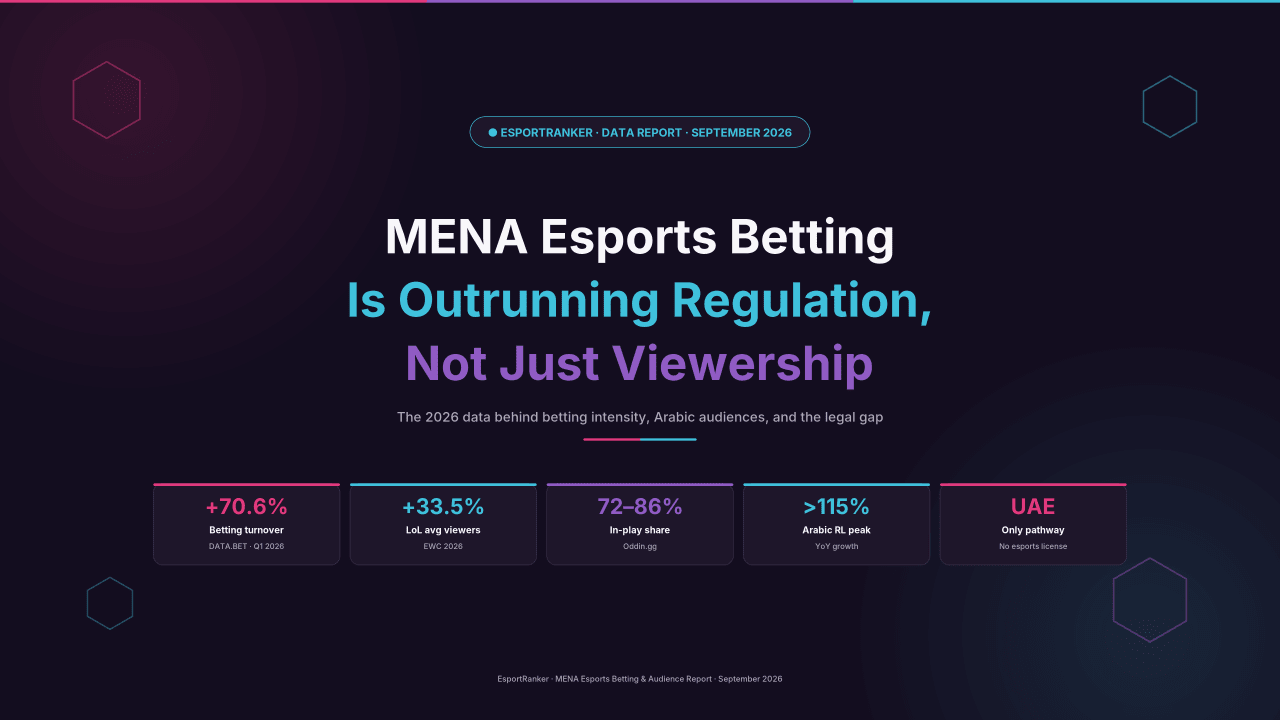
- Betting growth is outpacing the fastest comparable EWC audience metric. DATA.BET reported turnover up 70.6% year-on-year in Q1 2026, while LoL average viewers at EWC 2026 increased 33.5%.
- In-play wagering increases betting intensity without requiring equal audience growth. Oddin.gg reports that 72% to 86% of esports wagering activity across the five largest titles is live or in-play.
- Arabic esports engagement grew after EWC moved to Paris. Arabic Rocket League broadcasts increased peak viewers by more than 115% and hours watched by 58.16% year-on-year.
- The legal market remains highly restricted. Saudi Arabia, Qatar, and Kuwait prohibit esports betting. Turkey restricts sports betting to the state monopoly İddaa.
- The UAE is the main regulatory exception. The GCGRA provides a federal gaming framework, but esports betting has not been licensed under it.
The MENA esports betting analysis uses provider data, audience data, and regulatory reporting. DATA.BET supplies the Q1 2026 betting growth figures. Oddin.gg supplies the in-play wagering range. EWC 2026 audience figures come from public tournament reporting and Esports Foundation statements. Regulatory findings cover Saudi Arabia, Qatar, Kuwait, the UAE, and Turkey.
The methodology separates confirmed figures from estimates. DATA.BET's 70.6% turnover growth is a global network result, not a MENA-only result. EWC audience growth is tournament-specific. No odds or data provider reviewed by EsportRanker publishes MENA-isolated esports turnover. The comparison therefore describes the pace of two related market signals rather than a direct regional correlation.


MENA Esports Betting Is Growing Inside a Data Gap
MENA esports betting is difficult to size because public regional turnover data does not exist. MENA esports betting activity is therefore visible through indirect indicators such as provider growth, audience growth, operator marketing, and regulatory conditions. The main measurable betting indicator is DATA.BET's Q1 2026 network performance, which shows turnover up 70.6%, GGR up 91.4%, combination bets up 72.1%, placed bets up 33.2%, and active players up more than 56%.

Esports betting turnover grew 70.6% year-on-year across DATA.BET’s network in Q1 2026, compared with 33.5% growth in League of Legends average viewers at EWC 2026. The betting figure is global and is used as a growth-rate comparison, not a MENA-specific turnover estimate.
The growth rate is materially faster than the strongest comparable EWC 2026 viewership figure. LoL average viewers increased 33.5% year-on-year. The 70.6% betting turnover increase is about 2.1 times the 33.5% audience increase. That ratio is a growth-rate comparison, not evidence that the same users or the same geography produced both figures.
The missing MENA turnover figure matters commercially. Regional affiliates can observe Arabic-language traffic and operator activity, but they cannot verify the total legal or offshore esports handle with public provider data. EsportRanker therefore treats the lack of a regional breakout as a finding rather than replacing it with an estimate.
In-Play Betting Explains Part of the Growth Gap
In-play esports betting is a major source of wagering intensity. In-play betting lets users place repeated wagers after a match starts, which increases the number of betting opportunities generated by one fixture. Oddin.gg reports that live and in-play wagering represents 72% to 86% of esports betting activity across the five largest titles.
The high in-play share changes the relationship between viewers and turnover. One viewer can generate multiple wagers during one map, round, or match. A larger number of betting events can therefore raise handle faster than audience size. The 72% to 86% in-play range supports that mechanism, even though it does not identify MENA-specific behavior.
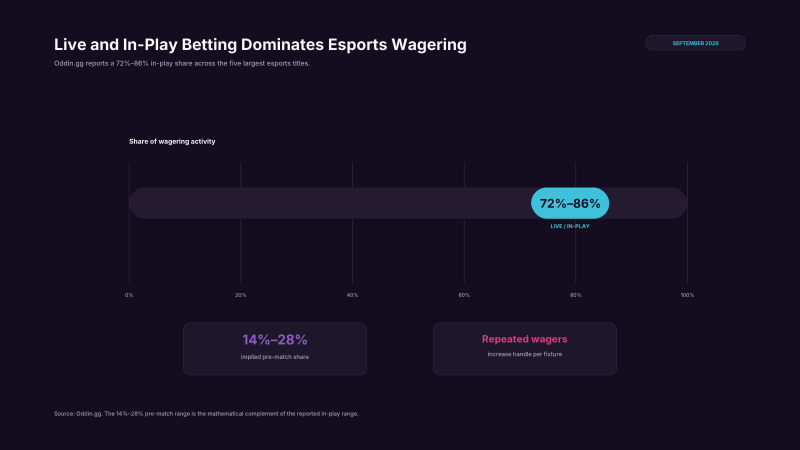
Live and in-play markets account for 72% to 86% of esports wagering activity across the five largest titles, according to Oddin.gg. Repeated betting opportunities during a single fixture help explain why turnover can rise faster than audience size.
Game preference creates another split. Counter-Strike 2 leads global esports betting turnover at 56% in the cited Abios data. League of Legends follows at roughly 24% to 26%, and Dota 2 follows at roughly 14%. MENA viewing has a stronger mobile-game component, including Mobile Legends, Free Fire, and Honor of Kings. The titles that attract regional viewers are therefore not identical to the titles that generate the most global betting handle.
Arabic EWC Audiences Grew After the Move to Paris
Arabic EWC viewership is one of the clearest regional demand signals in the dataset. Arabic EWC broadcasts expanded during a tournament that reached 850 million viewers and 440 million hours watched overall. The tournament increased total viewers by 13% and total hours watched by 26% year-on-year. Peak viewership reached 4.3 million during the LoL tournament.
Arabic Rocket League performance was stronger than the overall audience growth. Arabic was the most-popular broadcast language for the Rocket League tournament. Arabic-language Rocket League broadcasts increased peak viewers by more than 115% and hours watched by 58.16% year-on-year. Team Falcons won that Rocket League tournament, giving Saudi audiences a direct competitive connection to the broadcast growth.
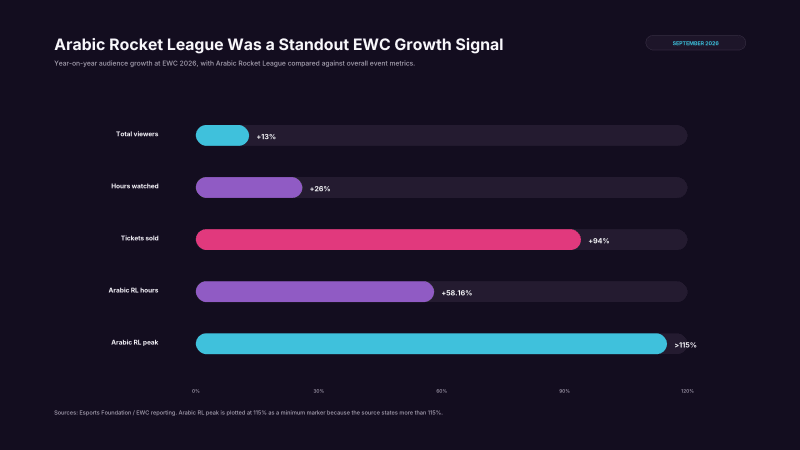
Arabic-language Rocket League broadcasts produced some of EWC 2026’s strongest audience gains, with peak viewers rising by more than 115% and hours watched increasing 58.16% year-on-year. Overall EWC viewers increased 13% and hours watched increased 26%.
The Paris relocation did not stop the Arabic audience increase. EWC 2026 moved from Riyadh to Paris after regional instability. Arabic engagement still expanded sharply. The result shows that the audience signal traveled with the competition rather than depending only on a Saudi host city.
MENA Esports Betting Faces a Legal Wall
MENA esports betting is prohibited across several of the region's largest markets. Saudi Arabia prohibits gambling, including spectator betting on esports. Qatar and Kuwait also maintain complete gambling bans. Competitive esports remains legal and state-supported in these markets, which creates a clear separation between esports participation and esports wagering.
Turkey follows a different model. Turkey permits sports betting through the state monopoly İddaa. Private and offshore betting operators are illegal, and enforcement increased under a presidential action plan issued in November 2025. Turkey therefore has legal sports betting, but it does not provide an open private market comparable with regulated sportsbook jurisdictions.
The UAE is the main regional exception. The UAE established the General Commercial Gaming Regulatory Authority (GCGRA) in 2023, and the regulator became operational in late 2025. The GCGRA is the first federal gaming regulator in the Arab world. Esports betting has not been licensed under the framework, so the UAE represents a possible future route rather than an existing regulated esports betting market.
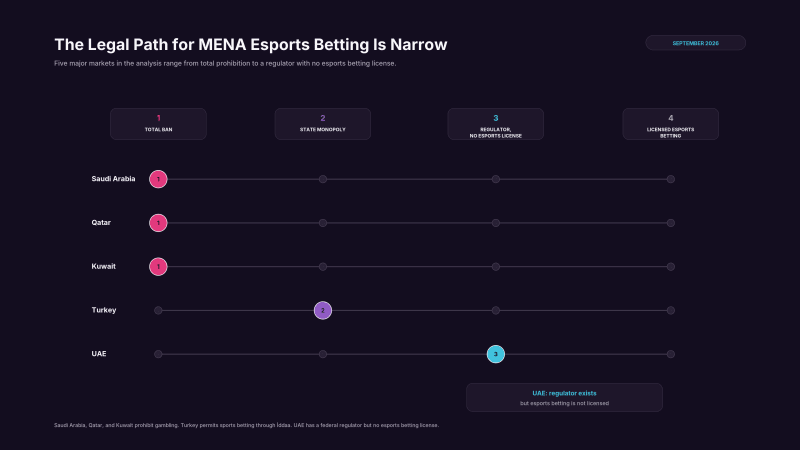
The largest MENA markets offer few legal routes for esports betting. Saudi Arabia, Qatar, and Kuwait prohibit gambling, Turkey limits legal sports betting to its state monopoly, and the UAE has a federal gaming regulator but has not licensed esports betting.
Offshore Sportsbooks Capture the Visible Commercial Demand
Offshore sportsbooks are the most visible betting brands serving Arabic-speaking users where domestic private licensing is unavailable. 1xBet, Melbet, and Parimatch appear in Arabic-language affiliate and sponsorship activity connected to MENA audiences. The brands provide a commercial signal that demand exists, but their visibility does not provide a verified measure of total MENA esports turnover.
1xBet has sponsored international esports organizations and has operated regional marketing aimed at Middle East and Africa audiences. Melbet has also promoted itself in the region and has held regional sports sponsorships. These examples show how offshore operators can reach Arabic-speaking customers even when local regulators do not issue domestic esports betting licenses.
The commercial difference is important for affiliates and operators. A regulated market produces licensing records, tax records, and clearer provider reporting. An offshore market produces less transparent data. MENA esports betting currently sits much closer to the second model across the markets covered in this analysis.
Team Falcons' Runner-Up Finish Is Secondary to the Market Structure
Team Falcons' EWC 2026 Club Championship result is a competitive setback, not a reversal of Saudi esports growth. Team Falcons finished with 4,600 points. AG.AL won with 5,300 points, creating a 700-point gap. AG.AL earned $7 million from the Club Championship pool, while Team Falcons earned $5 million.
Team Falcons still won individual titles in Rocket League and Street Fighter 6. The Rocket League win also coincided with the strongest Arabic-language audience signal in the dataset. The club's runner-up finish therefore sits beside continued Saudi competitive strength rather than replacing it.
The larger issue is structural. Saudi Arabia can support elite esports teams, large tournaments, and a growing Arabic audience while still prohibiting real-money esports betting. The difference between esports investment and betting regulation is the central MENA market tension.
What Changes the MENA Esports Betting Outlook
The MENA esports betting outlook changes if new regulatory or provider data appears. Three developments matter most.
- Watch for a GCGRA esports betting license. A licensed esports betting category in the UAE would create the first clear regulated pathway in the markets covered here.
- Watch for a MENA-specific provider turnover breakout. A regional figure from DATA.BET, Oddin.gg, GRID, Abios, or Sportradar would replace proxy comparisons with a direct betting measurement.
- Watch for changes in Saudi gaming-adjacent policy. Saudi investment in gaming and esports continues to expand, but betting remains legally separate from that strategy.
The current conclusion remains narrower than the headline numbers. Global esports betting turnover is growing faster than the fastest comparable EWC 2026 viewership metric. Arabic-language esports engagement is also growing quickly. Most large MENA markets still provide no legal private esports betting channel, and no public provider dataset measures the regional turnover that results.
Sources
Top 3 esports betting sites
- 1,500 USD
- 1,600 USD
- 120 USD
18+ · T&Cs Apply · Play Responsibly