


How a country of 33 million climbed to third in the world's most-watched mobile esports league — and what happens when a government decides competitive gaming is a national priority.
In November 2024, Malaysia's national Mobile Legends: Bang Bang squad stood on the podium at the IESF World Esports Championship and took gold. Twelve months later, they did it again. Back-to-back world titles at the sport's most internationally recognized governing body — the International Esports Federation, which holds IOC recognition as part of the broader push toward Olympic inclusion. That is not a fluke. That is a program.
What makes these titles matter beyond the trophy is the infrastructure underneath them: a professional league generating millions of dollars in media value, a government committing nine-figure budgets to esports facilities, and an audience base that is younger, faster-growing, and more platform-native than almost any other sports media demographic in Southeast Asia.
Malaysia's position in Mobile Legends: Bang Bang — the dominant esports title across Southeast Asia, the region's equivalent of League of Legends in Korea and Europe — is no longer a question of potential. The data says it has arrived.
How Big Is the MPL Malaysia Audience, Really?
The Mobile Professional League is the top-tier competition structure for MLBB. Each major Southeast Asian country fields its own edition; Indonesia, Philippines, and Malaysia are the three that move the global needle. To understand where Malaysia sits, you need to read the viewership numbers carefully, because they tell a more nuanced story than a headline figure alone.
According to Esports Charts, MPL Malaysia Season 14 reached a peak concurrent viewership of 870,049 — a figure that would place it comfortably among the most-watched esports leagues in the world during that period. Season 15 pulled back to 497,877 peak concurrent, a real dip. Season 16 recovered to 600,905. Those numbers span roughly 18 months of competitive play and trace a trajectory that looks, if you squint, like the kind of audience volatility any young sports property navigates.

Then comes the most instructive data point of all. MPL Malaysia Season 17, Week 1, recorded a peak concurrent viewership of 399,537. That sounds lower than the prior figures — until you apply the year-over-year comparison. According to Esports Charts, that figure represents a 133% increase compared to the same point in Season 16. The audience that showed up in Week 1 of the most recent season was more than double what had shown up at the same stage a year earlier. That is not a dip. That is a launch.
58% TikTok. What That Actually Means.
Platform breakdowns in sports media are usually treated as footnotes. In MPL Malaysia's case, the breakdown is the story.
Esports Charts data for MPL Malaysia Season 17 shows TikTok accounting for 58% of total watch time, with YouTube and other platforms making up the remaining 42%. That is not a marginal preference — it is a structural majority. And it tells you something specific about the audience that legacy media metrics would miss entirely.
TikTok's dominance here reflects a broader viewing pattern that is native to Southeast Asia: mobile-first, short-form adjacent, and demographically younger than the PC-native Twitch and YouTube audiences that Western esports properties have historically built around. The viewer watching MPL Malaysia on TikTok is not a casual fan who wandered in — they are a mobile gamer consuming competitive content in the same environment where they play. The context collapse between player and audience is essentially zero.
For advertisers and rights-holders, this is significant. A league where the majority of its viewership happens on TikTok is a league whose audience is structurally positioned for native mobile monetization in a way that older-format broadcast properties simply are not.
Third in the World. Here Is Why That Number Is Harder Than It Sounds.
Esports Charts ranks MPL Malaysia as the third most prominent MLBB league globally by viewership and regional reach. MPL Indonesia holds the top position. MPL Philippines is second. Malaysia is third.
That ordering makes intuitive sense at first glance — Indonesia has a population of approximately 275 million, the Philippines around 115 million. MLBB has been embedded in both countries' gaming culture since the title's breakout years. Their leagues had a head start in audience development, infrastructure, and sponsor relationships.
Malaysia, by comparison, has roughly 33 million people. A league of its size — operating at third globally in one of the most-watched mobile esports properties in the world — is punching significantly above its weight by any population-adjusted metric. To put it plainly: if MPL Malaysia were a country competing in a sport, its per-capita viewership performance would rank it among the highest in its weight class anywhere in the world.
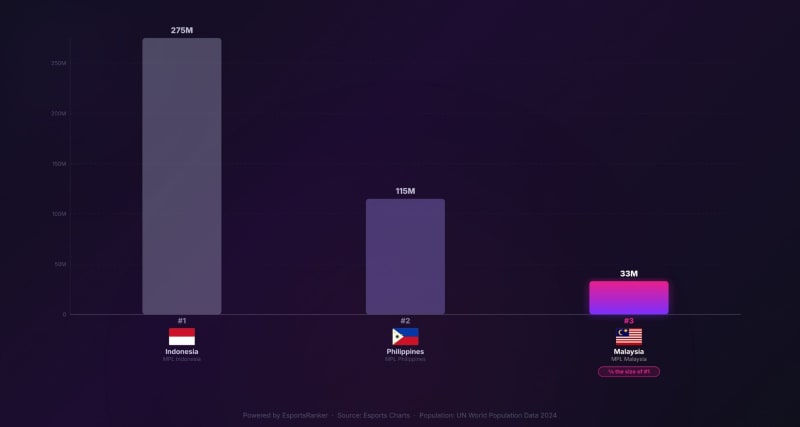
The gap between third and first is real. Indonesia's league regularly outperforms Malaysia's by raw peak concurrent numbers. But the directional trend for Malaysia — the season-on-season recovery, the 133% year-over-year Week 1 growth, the TikTok-driven audience expansion — points toward a league building structural, not cyclical, momentum.
The $1.09 Million Season, and What Media Value Actually Measures
MPL Malaysia Season 16, which aired in November 2025, generated $1.09 million USD in media value according to Esports Charts. Media value in this context refers to the estimated earned value of broadcast coverage — the aggregate equivalent of what that exposure would have cost to purchase through conventional advertising channels.
One million dollars in media value for a regional esports league in a country of 33 million is not trivial. It is the kind of number that moves a conversation from "gaming hobby" to "sponsorable property" in a CFO's office. It is also the kind of number that tends to compound — leagues with verifiable media value attract more sponsors, which fund better production, which draw larger audiences, which generate more media value.
The flywheel, in other words, has started turning.
RM20 Million and an Arena That Doesn't Exist Yet
In Budget 2025, the Malaysian government allocated RM20 million — approximately USD $4.3 million at current exchange rates — toward esports infrastructure. The funding is directed toward a dedicated national esports arena, currently planned for a 2026 opening, according to reporting from Bernama.
The specific allocation matters less than what it signals. Government budget line items for esports infrastructure are not, as a rule, what happens when a hobby gets popular. They are what happens when policymakers make a calculation that competitive gaming has become a credible export — of talent, of media, of international prestige. Malaysia has now made that calculation explicitly, in a national budget, with a specific ringgit figure attached.
The IOC recognition of the IESF, the back-to-back gold medals, the third-place global ranking — these are exactly the kind of signals that make a RM20 million commitment politically defensible. The arena that opens in 2026 will not be the cause of Malaysia's esports growth. It will be the physical evidence that the growth is real enough to pour concrete for.
The Women's Game Is Not an Afterthought
At the SEA Games in Bangkok in 2025, where esports was included as an official medal sport for the first time, Malaysia's women's MLBB team won gold. That result matters for a specific reason that goes beyond equity metrics.
A country that wins at the women's level is a country with depth. Elite women's esports performance requires a player pipeline, structured competition pathways, and coaching infrastructure that casual participation does not produce. Malaysia's SEA Games gold in the women's division indicates that the talent development system is broad, not just concentrated in one flagship squad.
It also positions Malaysia as competitive across both open and women's brackets of the most prominent MLBB international events — a distinction that only a handful of countries in the region can credibly claim.
What Would It Take to Catch Indonesia?
MPL Indonesia's viewership advantage is not purely cultural. It reflects years of investment by broadcasters, telcos, and endemic sponsors who moved early and built audience habits over time. The Philippines has similarly long-established infrastructure. Malaysia is working from a shorter runway.
But the gap is not structural in the way it might be for a traditional sport, where population size functions as an effective ceiling on talent supply. MLBB is a mobile game. The barrier to entry for competitive play is a smartphone. Malaysia's mobile penetration rate, its young median age, and its TikTok-dominant viewing demographic are all inputs that make rapid audience scaling more plausible than it would be in a sport requiring physical infrastructure.
Back-to-back IESF world titles are what tell the next generation of Malaysian players that the ceiling is not fixed. That the country that once sat at the margins of Southeast Asian esports now has a flag at the top of the podium — twice. Whether the 2026 arena converts that symbolic momentum into a structural competitive advantage will depend on how well-designed the talent pathways inside it actually are.
The investment is made. The medals are real. The audience is growing faster than it was a year ago, on a platform that reaches exactly the demographic that will define what esports looks like in a decade. Malaysia does not need to catch Indonesia to matter. It has already become the third most prominent MLBB league in the world, in a country one-eighth the size.
That is the story. The rest is detail.
Sources: Esports Charts (MPL Malaysia viewership data, platform breakdown, media value, global league rankings); International Esports Federation / IESF (World Esports Championship results 2024, 2025); Bernama (Malaysian Budget 2025, RM20 million esports allocation); SEA Games 2025 Bangkok (women's MLBB gold medal result).
Top 3 esports betting sites
- 1,600 USD
- 1,500 USD
- 1,750 USD
18+ · T&Cs Apply · Play Responsibly


